


(Beginner) Ask Not What Cardistry Can Do For You, But What You Can Do For Cardistry
I would never claim that I have or ever will reach the heights that Noel Heath, Patrick Varnavas, Tobias Levin, and other heroes from the cardistry scene have. This is something many others have long come to terms with, but I constantly see newcomers with this mentality for greatness. Becoming a better person and working on your craft is great. When it spills into what we get or deserve from cardistry, however, then there is a problem.
Newcomers to cardistry constantly come into the scene and work (from their perception) very hard without anything to show for it. I’ve personally seen this burnout happen time and time again because most of the listeners from my old podcast (Cardistrytalk) fit the beginner demographic. I used to think the same way and viewed creating moves as a competition, something to prove that I was a better cardist — to get higher up in an unseen hierarchy. When creating with the intentions of getting something back from others, I was miserable. “Hustle” culture has infiltrated our lives so much that it has even spilled into our hobbies.
Questions like how do I get more decks, likes, and respect have become the focus. I want to pose a different philosophy to newcomers. To show the benefits that come from a mindset of how much I can give instead of how much I can get. The more we give to cardistry or anything in life, the more we usually get back. I’ve given 100s of hours to creating and running Cardistrytalk, and in return have made numerous lifetime friendships. There were moments when I felt Cardistrytalk was a waste of time, but now I view it as one of the best things I’ve done with my time. I spent thousands of dollars to go to 3 Cardistry-Cons and, in return, have received memories, travel stories, and new perspectives. Cardistry is so new and small that there are so many ways to give, and it is honestly shocking. Just off the top of my head, we lack news shows, memes, essay videos, history preservation, biographies, in-person classes, and much more. Find an area to give, and you will usually find much more happiness and satisfaction because you are loving the process and not the momentary results.
(Intermediate) Steal, Steal, Steal
Mark Twain has a quote that I love:
“There is no such thing as a new idea. It is impossible. We simply take a lot of old ideas and put them into a sort of mental kaleidoscope.”
The notion that new ideas don’t exist is not a new concept, but it is an exciting one. We don’t have to feel the pressure of creating something new because it has already been done. We just have the privilege to play around with what was left behind. I’ve seen the pressures of creating something new burn out and destroy cardists. My recommendation is to realize that your goal shouldn’t be to create something new, but instead to make something your own. So look at what’s been done by cardistry legends or up-and-comers. For example, one of my favorite cardists at the moment is luke.mcn. He is constantly innovating the aerial and stunt move space. He has posted a move using his cap as a perch to do a foot stall.
This was really fun to me because of its uncommon integration with a hat. The slow-mo on the swing cuts on the end is also hilarious. I knew I could easily adapt it into a card in a fan. So after seeing it during my lunch at work, I went home and immediately filmed my take. Without having to see if I could do it myself, I already knew and set up the camera without having done it before, and got it on my third take.
Seeing what your favorite cardists have done or are doing can be a great inspiration, but also keep your eyes and ears open to everything because you never know where an idea that hasn’t been viewed through the cardistry lens is. I have fallen in love with @jacob_acrobat, an acrobat, juggler, and all-around chill guy from Canada. I encourage you to look at his posts because im sure you’ll find something worthwhile. One of my best-received posts, featured below, was just a straight-up theft from one of his knife stunts.
This was another idea that I knew I could easily adapt to a card in a fan by using 2 decks and concealing one fan in my pants. Once again, without having done it yet, I filmed it the next day.
I could continue with more examples, but I think this gets across the point. In the process of adding more and more ideas from different sources into our kaleidoscopes, it becomes easier to have a result that feels new to others.
(Expert) Love Your Move’s History
My most recent discovery around cardistry is how important it is to love moves; to understand why they work and how; where the move came from and who made it. Every detail you can obtain is important. My favorite move of all time is the Card In Fan, to no one’s surprise. It is a move that is quick, flashy, and can be consistent if you practice. Despite being my favorite move, I knew very little of its origins or variations until recently. Information on moves are shockingly scarce, and it should be everyone’s job to preserve this info. Until recently, I didn’t know the exact details, but Andrei Jikh posted a video on Christmas 2007 showcasing the move and variations. I had many sources saying that they thought Andrei Jikh first brought the move to life, but didn’t have evidence until recently.
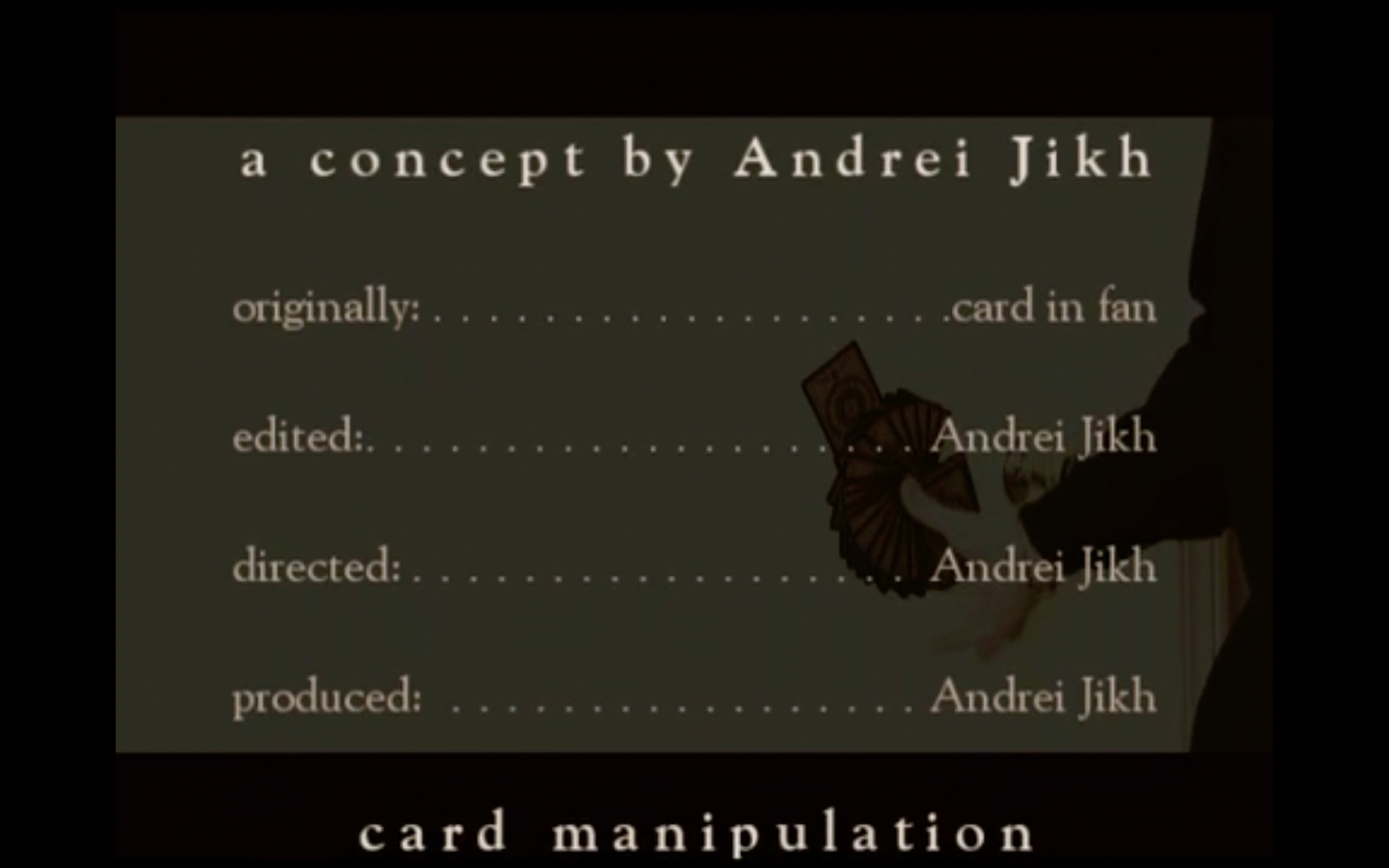
Before I knew the origins of the move, I searched for any variations I could find with an obsession. I searched far and wide across the vast worldwide web and have since compiled around 50 variations on the move from 2007 until now.
This has provided me with a base of knowledge to know what has been done and what has not. One particularly late night while looking at videos, I found Nikita Yatsik had already posted a video doing a Card In Fan using an invisible thread, and Aviv doing a Backdrop to Card In Fan. Both of these were variations I thought I’d created. While devastating at the time, it showed me I was on the right path. If you’d want to be in the cardistry headspace of anyone, it would be them! With all the knowledge I have gathered, I have created the space for me to create variations freely and constantly. At this point I have contributed around 10 variations to the Card In Fan scene and hope to one day be considered the cardist who has the most variations of the move.
The reason I bring all of this up to the experts of cardistry is to present the idea of loving your own move in the way that I love the Card In Fan. The best of this field are making art and performing feats with cards that have never been done before. We owe it to ourselves and future generations to recognize the significance of this. Many hobbies started before the internet, when information was hard to preserve and spread. Chess is over 1500 years old, and I think any respectable chess player would love to hear about how it was made and the early tactics of the game. With modern technology, it is much easier to preserve and spread this type of info. I want more creators to not only share the how, why, and when they created a move, but also to do it excitedly because other hobbies were not granted the ability to do this, and because what we are doing is impressive.
Final Thoughts
I’m not much of a writer usually, so I want to quickly thank Kevin for having me on and helping me with the process. Kevin was on the 7th episode of Cardistrytalk back when I had no following or notoriety, and I remember being starstruck at the time. His interview and Sean Oulashin’s made me feel like I had made it. I think he is a perfect example of giving to the community because my skills at the time did not deserve a top-level interviewee. I’ve been in the community for a while now and hope that my insights can help others avoid some of the traps I fell into, and inspire others to be more creative or care more about their hobby.
About the author, Caleb Smith:
Hiya, I am Caleb Smith. You may know me from my old podcast CardistryTalk or my Card In Fan Friday challenge series. I perform a new card in fan variation or idea every week on Instagram and Tiktok for this challenge. This article actually marks ½ a year of weekly posts. It will be difficult to hit the last ½ year, but I’m excited for the challenge!
When not making new card in fan variations, I like to stay active playing soccer or with a yoga session. After being active, I’ll usually go to the sauna for a bit to relax and recover. I also enjoy thrifting, reading, and movies when at home, with a special interest in Stephen King and Star Wars. Im based out of Cincinnati, Ohio, and would love to jam with anyone passing through the motherland of playing cards.
If you enjoyed my article, feel free to chat or see what I do next @CalebsCardistry!
Like what you read? Leave a comment below telling us why: