

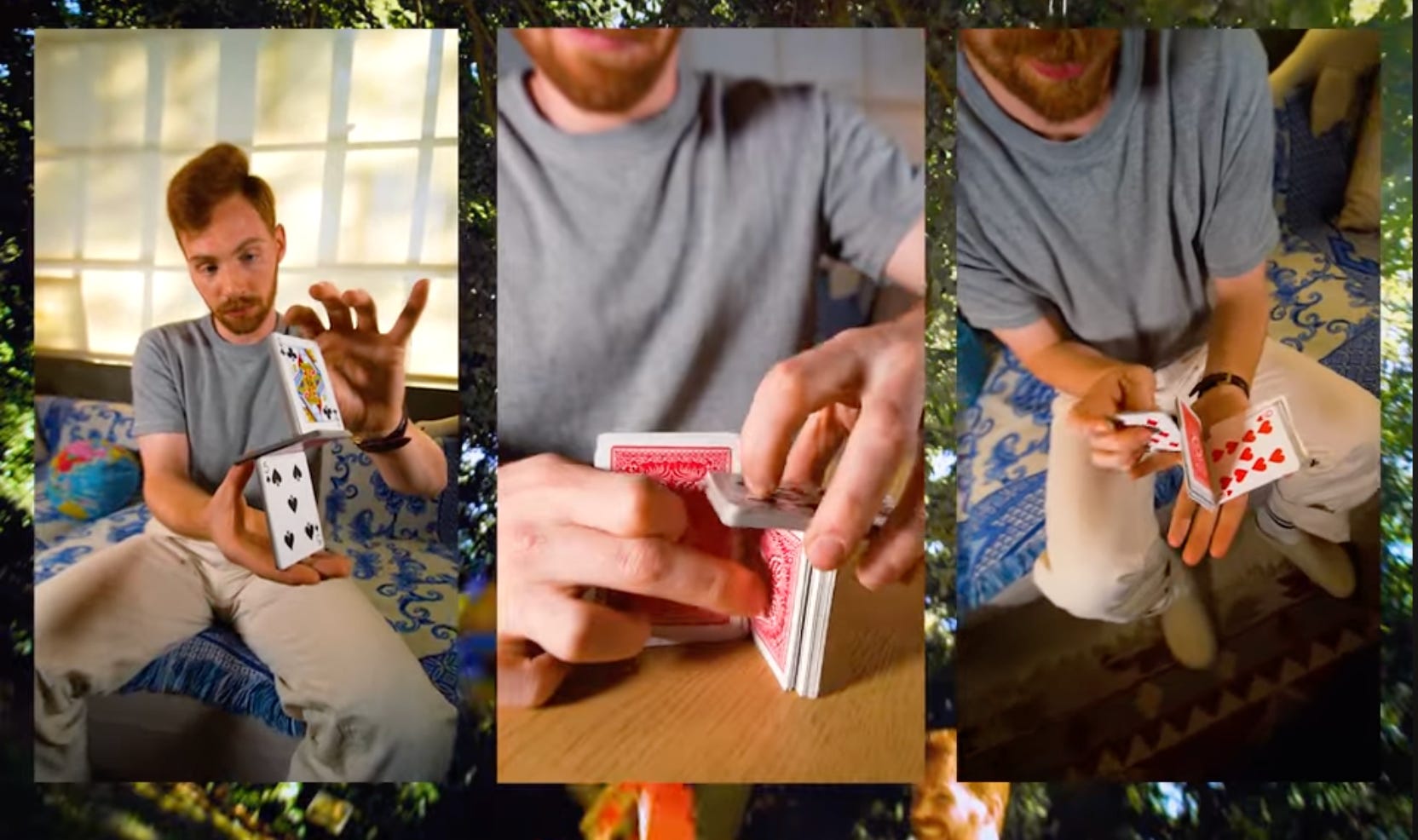
I just want people to feel like they’re in control early on because what they’re doing is difficult and unnatural. So if I can remove as many elements that are unnecessarily adding strain or discomfort, discomfort, I feel like that’s an obvious goal to have.
WSLT:
Okay, so we’re here today to talk about what you call “modern beginner moves”. Do you think you can define what that is for our readers?
PM:
I think what it boils down to is that, for the longest time, we’ve been having the problem with beginners wanting to get into cardistry and we’re just throwing them into what we began with in this art form. We went back to the things that we began with, but those moves may not be the best place for people to start. It’s just the resources we had at the time.
So I think there’s a lot of conversations that can happen around what "modern beginner cardistry moves” are and how we are designing moves to be that. And what we mean by that is moves that are creating a better foundation for people who want to learn cardistry. You’re developing and using mechanics that build off of each other more critically and in a better sequential way.
Like, maybe we always taught people to do the Charlier Cut first because that’s what we learned first. And we’re like, it’s one-handed and it’s two packets, but is that the best move for someone to learn first? Why is a table spread not a better idea, where they’re learning card control and they can build confidence and not worry about holding it in their hand, or what does it look like to create a move that you can specifically break down?
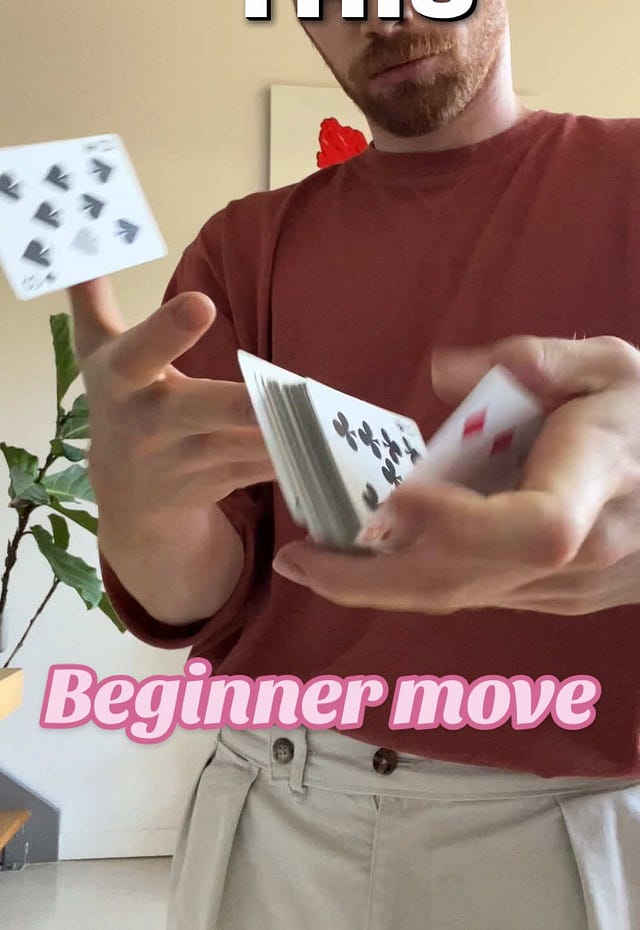
An example of that is a move I started working on that became kind of the beginning of this thought process, which is called “Angel Roll”. It involved Angel-ing a card, rolling the entire deck to the other hand, and placing the Angel down on top.
 Tiktok failed to load.
Enable 3rd party cookies or use another browser
And the idea there was, “how can you make a move that you don’t have to learn like a sequence?” So the example we talked about yesterday with somebody was like, I don’t know if you’re familiar with this game or not: Cat Mario. Do you remember this?
WSLT:
I know Cat Mario, yeah, yeah.
PM:
Yeah. A rage game. It’s all about going forward, something happens, you fail and you fall. And like, having to keep memorizing random steps… learning cardistry moves as a beginner feels like playing Cat Mario, in my opinion.
Like there’s an aspect of, you’re watching a tutorial and everything crumbles and falls and you pick all the cards back up and you begin again. And you’re just doing this slow progression forward.
So instead, how do you create moves where you can be like, “learn an Angel” and someone can sit there and practice Angel-ing a card over and over again, learn a deck roll and they can learn how to do this back and forth and they can progress at those two things at their own pace? And then when they feel competent at both of those, they can combine those into a move. So it’s challenging. How are we designing moves to be more approachable for beginners and build off of things well to where they’re not just being thrust into it as crazily as all of us were where we went from the Charlier Cut to Sybil with a crazy jump in skills?
WSLT:
Incidentally, what was the move that got you into Cardistry?
PM:
See, this where I come from magic. It would probably have been going back to like Riffle Shuffle and a bridge. I saw that and I was like, “I must learn that” and spent months and months and months of the seventh grade being like, “bad, bad, bad”. And then from there, it probably was because I got indoctrinated through the YouTube pipeline of magic to cardistry with Sybil and false cuts. And then seeing all the Dan and Dave stuff and then discovering who the Danes were and that kind of progression, which I feel like is like extremely common from people like myself who were like getting into cardistry around the 2010 to 2013 era.
WSLT:
How would you say today’s beginners are different from someone who was starting out back in like the 2010 to 2015 era?
PM:
I think what’s different for them is there’s a more defined ecosystem for cardistry. When they look up “cardistry”, they see a larger variety of stuff. And sometimes some of the first things that are coming up are tutorials now. You’re not just looking up cardistry and finding solo videos; you’re looking up cardistry and tutorials are coming up, whether they’re SQUAREUP or Lotusinhand videos.
I also think people are discovering it more casually than we all were. I think they’re discovering it through social media, through TikTok, through all of these things. I think Haider, the SQUAREUP up guys, all these people are doing these big pushes on social media towards beginners. We’re seeing people get interested in cardistry through that. And I think what’s interesting about when people are getting into it through social media is that sometimes their first experience with cardistry is someone talking about cardistry, which I think is crazy.
WSLT:
So when it comes to people learning cardistry, what do you think gets people to quit in the first week? What are the roadblocks?
PM:
I think it’s hard. There’s usually a lack of tutorials to walk you through it. But usually if people don’t have a person in their life who’s interested in encouraging them and showing them the right videos, or passing along the right tutorials or giving them tips and tricks or helping them learn that, for example, “you’re using a way-too-brand-new deck of cards when you’re beginning and that’s going to make it hard; maybe let’s find an older deck of cards for you.”
I think those are the things that I’m seeing more cardists figure out. We need to have forums again. We need to have resources out there: workshops, places where as people get into cardistry, it’s a more encouraging environment to get you to stay and understand what the community and art form is. Because I think some people also find out about it and they’re like, “it’s just shuffling cards”. Some people find it more through the community and jamming side. So I think there’s also a lack of clarity of what the cardistry community is and what we do and why we do it. And so I think people just get lost in all of that. It’s very overwhelming. They start to learn about it. They start to dive deep and then they get a little confused and they kind of are dealing with moves that are way harder than they expect. And then they’re like, “I’m going to go learn to skateboard” and they just pivot on.
WSLT:
I guess what you’re talking about with modern beginner moves is already one step towards that. So — what can make a move feel good early on, even if it’s done badly?
PM:
I think if people can track how what they’re doing will allow them to do something cooler in the future. Myself, Carter Macdiarmid and Kyle Tran, were just having a conversation about this yesterday where we were talking about why we think the table spread is one of the best beginner cardistry moves to learn. And it’s because they can learn it easily on a table and it feels nice. It’s satisfying to do.
That’s low risk. They’re not having to do it over the ground or anything like that. They’re learning that deck condition matters. They’re learning that where you do cardistry matters. You can’t do a turnover spread and a table spread in a park. They’re learning small subtleties. But then what you can do the second they start to learn that is go, “here’s all the possibilities that you can do with this thing.” Arm spreads. You can do spreads in a move and turn them over. You can throw them in the air. You can catch them on your feet. People do spreads on legs, on tables. You can show them Lars’s caterpillar-walking-spread move. And you can just be like, “you’re just learning the basics for all of this. What you did theoretically transfers into this one day as you develop skill and hand-eye coordination.”
I think that’s super beneficial for people getting the itch because they learn something quickly and then they go, “if I work on this and get really good at this, I can do these other cooler and bigger things.” And it’s really transferable as opposed to just teaching someone the Charlier Cut and then going, “now go do Ladies and Gentlemen 2 by Quentin”. That disconnect is massive.
It’s more similar to skateboarding where it’s like, you don’t learn to kick flip first. You learn to Ollie first. And then you’re like, I can get in the air. Now I need to spin the board. I can now do a Kick Flip. I can now add a Shove-it. And if I do a Shove-it and a Kick Flip, all of a sudden I’m doing a Varial Flip. Then you’re building off of it more easily. And I think cardistry lacks some of that building-off-of-itself early on.
WSLT:
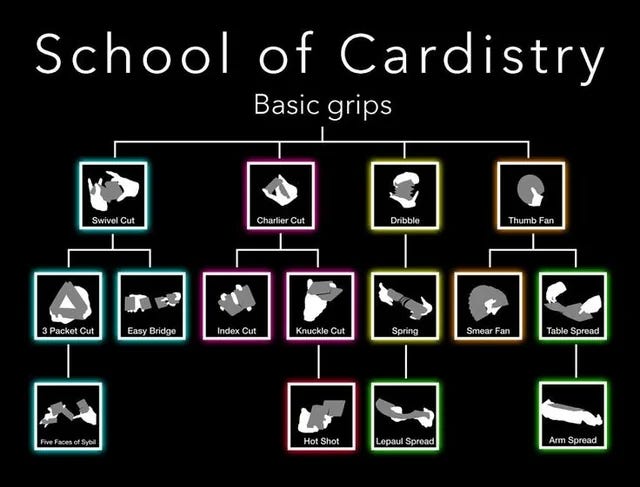
That progression reminds me a lot of those skill trees that you see in RPGs. What do you feel like is the most helpful roadmap that we have currently in the scene? Is it Lotusinhand’s boot camp, or anything else that comes to mind, or is it just not in place yet?
PM:
I think it’s not in place yet, but I think there are phenomenal things. I think the best skill tree we have currently is Lotusinhand; I’ll give them credit for online library with free access through YouTube. They win that hands-down. I think theirs is the best in that category. I think SQUAREUP has the best community for beginners with their Skool course that’s going on right now that costs $5 a month, where you get access to jams and office hours with them. There’s 130 members of that community, I think, where people can post ideas, get access to all the SQUAREUP tutorials that are labeled level 0 through 10. They can ask questions, things like that. I think SQUAREUP wins for that. I still think there’s a lot to discover in that early age. But those are the people I would give credit to right now: SQUAREUP and Lotusinhand for different sides of it. I think between those two resources, that’s a pretty good place for beginners to begin at.
WSLT:
Awesome. So when we’re talking about these modern beginner moves — Andrew Avila and I call them ‘gateway moves’ —which moves do you think succeed as gateways and which of them secretly fail?
PM:
Mm, fun.
We mentioned that a table spread and Angel have an immediate effect and they’re cool. Like, immediately showing somebody Angel and being, like, “you can do that now” is like an immediate click.
Now, I do think there is a danger in moves that are too self-working and only learning those at first, because you lack some of the parts that are necessary for cardistry, which is the desire for a little bit of dexterousness, like really working on something. Kyle and I have debated for long periods of time: when do you teach someone the Charlier Cut? Because I still think the answer is that the Charlier Cut works early on. I just don’t think it’s the first three or four moves you show people or teach people.
When it comes to other great gateway moves, I think there’s a lot to discover with table moves. Jack Trathen and I have had some fun calls about doing table sequences of balancing a pack on the end of a table and dropping another packet from above. So it hits the lower packet, that flips over, and you catch that in your hand, and now you’re teaching people packet management without the risk of dropping cards everywhere. You get to sit down and work on it. I think table moves have a lot of gateway potential.
And then I do think the Charlier Cut makes its way in there. Because I do think the Charlier Cut is a proper, “this is tough” kind of move, but I’ve seen enough true beginners get the Charlier Cut down in 30 minutes. Not well, but that’s also why I think the Charlier Cut is nice because you can teach people why ‘steez’ (style + ease) matters.
I think people mess up immediately after the Charlier Cut. I’ve seen people try to teach people the One-Handed Revolution right after the Charlier Cut and that’s insane to me. Sure, it feels natural. You’re like, “yeah, you just add a spin now”. But it’s not just adding a spin. You’re adding in a level of dexterity that people just do not have yet. It feels like a crazy jump for being such a small thing.
Then there’s fans. I think that the thumb fan is actually a great place to go for people because you’re teaching them the differences of how where they hold their thumb affects how it looks. And you can really position a deck in someone’s hand, or even you could hold it and they can spread them out or vice versa. Alejandro’s Polland Fan is a great gateway.
I designed Angel Roll to be a gateway. Myself and Carter are actually spending some time right now working on designing more gateway moves. Because I think it is under-explored. It’s like, the concept is there. I’ve made one, but I want to spend more time making more and see, did I get lucky or did I actually hit a concept that works well?
So in the process of seeing how replicable that is, that’s kind of the fun we’re in — that testing phase with this concept, almost.
WSLT:
Over some voice memos that you sent me a while ago, you mentioned something about “designing moves that teach mechanics intuitively.” And I thought that was really interesting. Can you expand more on that?
PM:
Yeah, I think it’s like, things that your hand naturally wants to do. For example, hands want to expand. So how are we designing moves that like focus less on doing a funky hand position? What is it about spreading your hands that is intuitive? How are we designing moves that have maybe a spread element like that in them, because that’s intuitive of holding something and spreading forward?
We just need to think about movements of people who haven’t trained with cardistry. When most people grab a deck of cards, they don’t immediately go into dealer’s grip. But we assume they do, or understand that this is the best place to go. A lot of times when people hold cards, it’s really aggressive. So maybe it’s thinking about what can be done from that position that makes sense.
So I think it’s challenging ourselves to think back to what it felt like before we knew how to hold a deck of cards when creating these moves, which is tricky. And something I was even doing when I was creating Angel Roll is I was first trying to teach myself to do it with my non-dominant hand.
WSLT:
Right, right, right.
PM:
That’s a good test of like, how does it feel immediately when I try to do this in the opposite hand? Does it feel almost the same or does it feel nicer in this hand? Like, does it feel like I’m really having to work hard to make this work? And I think that’s a fun skill we could be thinking about.
Now the damage is do you then all of sudden accidentally make your non-dominant head so dextrous that you’re blind to how hard and easy something is? That’s its own thing we’ll have to worry about.
WSLT:
Right. And it also has me thinking, I wonder how many people we’ve ruined with teaching them cardistry the right-handed way when they might actually be left-handed people.
PM:
So, I’m a fascinating example of this: I am a right-handed person and I do cardistry left-handed. And it’s because I was watching tutorials and I was mirroring. So I was watching Jay Sankey magic tutorials and it was like, “hold the deck, bring your hand over”. And I just was mirroring that. And then finally, like a year in, they were like, “now pick the deck up with your left hand.” And I was like, “What? Left? Who said anything about holding the deck in your left hand?” And so I naturally learned the opposite way that I should have technically.
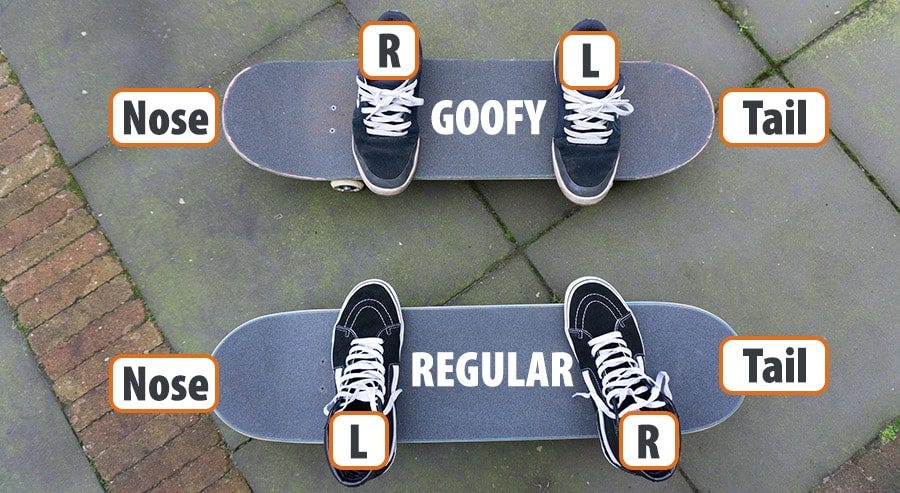
I think we have it in our brains that you either do cardistry right-handed or left-handed. I honestly think that’s a flawed system. You don’t call goofy or regular in skateboarding ‘right-handed’ or ‘left-handed’. It’s not like, “are you right-handed? You must push on a skateboard with your right foot.” You just go, what feels natural?
WSLT:
What would come into play when designing an ideal beginner/gateway move?
PM:
The thing that my brain immediately jumps to is removing as much risk for embarrassing failure as possible. I think removing the possibility for a 54-card pickup on the ground is ideal. That’s where my brain first goes, whether you’re focusing on a single card or whether you’re using a table. I want a beginner to feel in control in the same way that we feel in control when we’re doing a larger packet cut, or at least getting them as close to feeling in control. And I think that plays with thinking about what natural hand movement is before you pick up a deck of cards.
I just want people to feel like they’re in control early on because what they’re doing is difficult and unnatural. So if I can remove as many elements that are unnecessarily adding strain or discomfort, discomfort, I feel like that’s an obvious goal to have.
WSLT:
Do you have any remaining or closing thoughts about modern beginner moves that you’d like to share?
PM:
People should just make them. People should figure out what I mean when I say that. I’m in the process of figuring out what I mean when I say that, but… I think too often people wait for a thought to be perfectly formulated and perfect before they preach it. I’m a big fan of people’s half-baked thoughts. I love hearing where creative and talented people are at with something and I don’t think this is something that I feel like is extremely unique to me.
I know other people have expressed the same concept. This is not entirely me inventing something, but it’s definitely a topic that I think is really fun. And I would love to give it more vocabulary and flesh it out. And I would encourage people to do the same. And if people end up with better theories than mine, perfect. Then we’ve got better modern beginner cardistry. And at the end of the day, that’s what matters most of all is just, more of us should be thinking about it. That’s my big thing. I would love more people to go, what does that mean to them? And start thinking about it and start creating it. And maybe it’s not the flashiest thing, but I do think there’s something really special that I’m seeing more from people in the community. And I think it’s people who are getting a little bit older, people even my age.
I’m 26. There’s a large gaggle of us who started cardistry when we were 13 to 16 and grew up in this hype, ‘cool' era through high school into college. And now a lot of us are looking at where do we fit into the community? And a lot of us are reflecting on the fact that we got into it young. How did we get into it? What can we do to further improve this field other than just creating brands and creating decks of cards and creating cool solo videos?
And so I’m seeing more people want to put attention on that beginner aspect. And that makes me really happy and excited because it feels like a lot of people wanting to make this community last longer and grow beyond just being the coolest and best person at it, which I think is a necessary thing for every community that is successful is it’s not just everybody rushing to the top. There are plenty of people who are super content with just building out the foundation of it all.
Kenneth gave a phenomenal talk at the Portland Cardistry-Con. He opened the entire Cardistry-Con with a presentation that was like, “you do not need to be the best to enjoy Cardistry.” It was all about like, “Hey guys, it’s okay to just enjoy doing this. It’s like, I know we’re all here to see the hypest videos. It’s okay to just feel like we’re fine and decent, and we’ll have a fun time doing that. It’s important someone tells you that’s okay.”
And I see that sentiment coming back more and more recently as people are just like, “I’m kind of burned out with creating moves, but I don’t want to leave this community. What can I do?” And I’m so excited to see where those people put their energy.
About the interviewee, Parker Mitchell:
Parker Mitchell is the creator of building blocks, is based in the East Coast of the USA, and has been a cardist for 14 years.
He can be found @parkermmmm on Instagram, and @card.worm on TikTok.
What did you think of the article? Tell us in the comments below!