

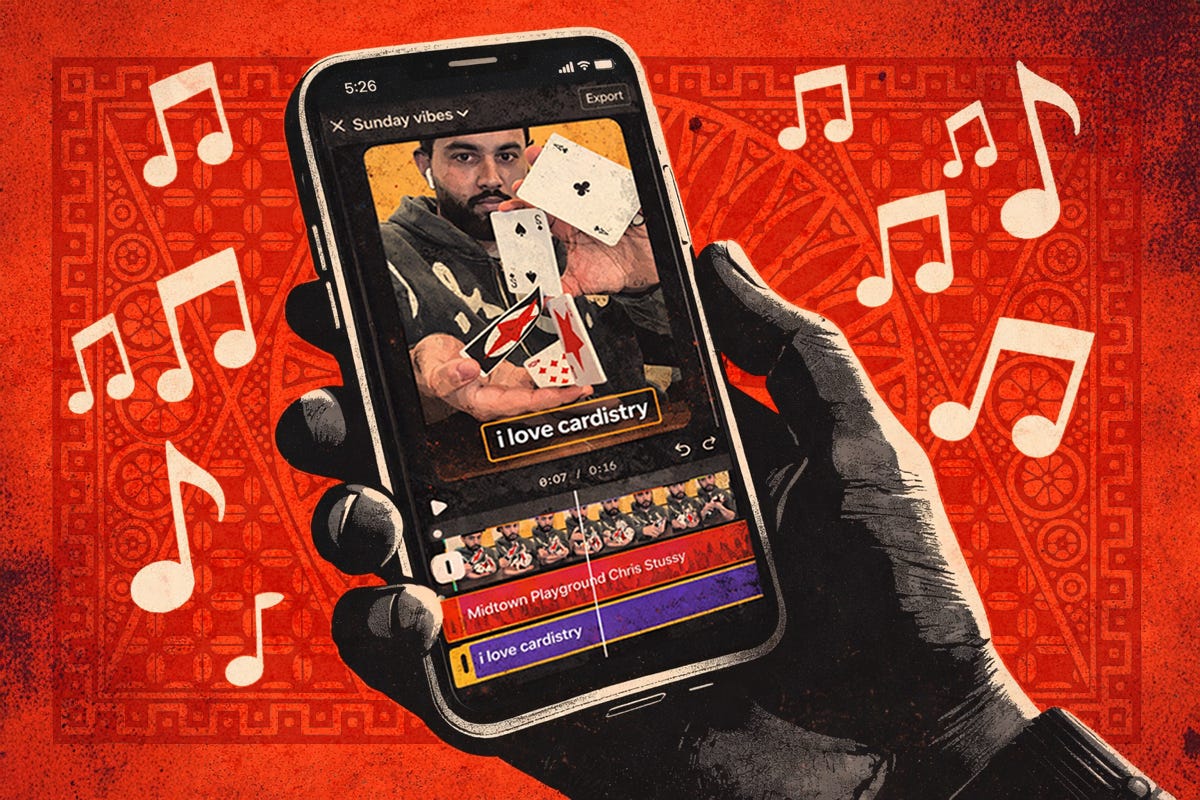
Here you are again, about to post another IG reel debuting that new move you spent the last two and a half weeks working on. Yet you’re stalling. Deleting and restarting the post over and over again. Hoping that this time you’ll catch the vibe and be able to find the perfect song to go along with that clip you spent the last 20 minutes trying to film.
Should I use that trending rap audio or that obscure track I really love but that might make me come off as a weirdo? Or maybe I should just skip the music altogether? The sound of clapping packets and the rumbling of the washing machine could be a vibe, right?
If these are the thoughts that go through your head every time you go to make an IG post, you are not alone. Cardistry is a kinetic art form that relies on the elements of pattern recognition, novelty, surprise, and rhythm to be appreciated. As is music. A good backing track can only further emphasize what makes a move interesting in the first place. In other words, a well-curated audio experience can’t save bad cardistry, but it can definitely make great cardistry even better.
When Raw Audio Works Better Than Music
This is what I was asking myself a couple weeks ago. Should I even bother with music? At that time, most of my posts had no music at all. The sounds that came though my iPhone mic became the un-edited audio for pretty much all of my videos. Sometimes I was lucky to get ASMR-ish vibes with cards riffling and sliding against each other, while other times my oven would start beeping or my girl would be chatting away on the phone far off in the distance.
That’s when I decided to take to my trusty IG story poll to ask my audience: “Which do you like more? With music or raw audio (no music).” The poll was accompanied by two instances of the same cardistry clip, one with a carefully selected song and the other with just the raw audio. The results of the poll surprised me…
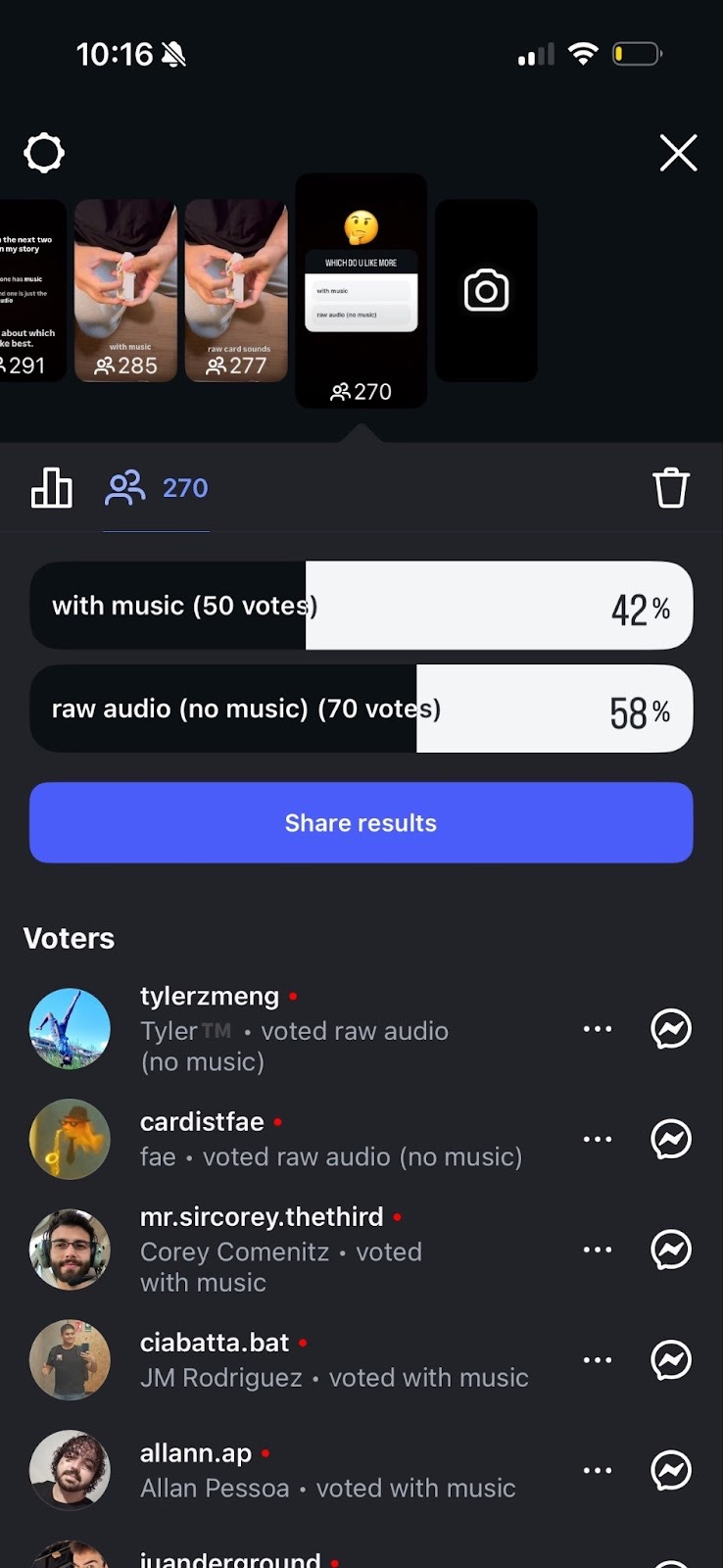
It looked like a majority of the votes preferred no music (70 votes versus 50 votes). Shocking, I know. I was always under the impression that when you have music it would be a more enjoyable watching experience because of the cross sensory stimulus between the kinetic cardistry and rhythm of the audio. But clearly this was not the whole story.
Many voters also sent me accompanying DMs to give more context for their choice. Those in favour of raw audio mentioned they liked the ASMR nature of the card sounds, and some even mentioned that they liked the silent moments. Interestingly, a handful of DMs made a more personal observation, mentioning that no music just suited my style specifically and that my cuts “sounded good.” If that isn’t a cross sensory compliment I don’t know what is.
The main takeaway I got from that group was if the audio sounds good, keep it as is. And when you have some not so great audio, use music as the bandaid to wash over the car alarm from across the street.
Music as Ambience
Between the two options of with or without music, I got a handful of nuanced perspectives that were on the fence. They liked the structure and synchronization of the music but also appreciated the rawness of keeping the original audio.
This made me realize there was a hidden third option which was a combination of both. Of course you could overlay a track and mix the original but this doesn’t always work. Instead, you could just play music in the background out loud WHILE you film the clip. Mind = blown. You would be impressed how well your smart phone’s mic can record ambient background music while also capturing the subtle slides and riffles of the cards.
The other awesome part about filming while playing music out loud is that you can really time the moves and adjust the cadence to match the music in real time. It adds so much more to the overall style and presentation. Often, you will find that different styles and BPMs will come through in your performance.
On a higher level, the vibe and energy of the music can change your internal state and inspire small stylistic moments that wouldn’t otherwise happen like a cheeky flair, an impromptu deck roll, a suspenseful pause, or even a perfectly timed TG deck flip. Careful with those TGs though, they can really scrap an otherwise perfect clip with an unexpected rogue card flying off… but that’s a topic for a different article.
Double Down on What Your Move Emphasizes
Over the last 15 years or so of posting cardistry, I have made some observations and recognised some patterns when it comes to the types of music used in cardistry content. The best way to leverage it is to be self aware of your own style and what you are trying to highlight in a given clip, video, or move.
When it comes to cardistry there are certain attributes in a move or combo that make it worthy of being considered interesting: novelty of the mechanics, attitude of performance, establishing and breaking patterns, build and release of tension, surprising moments, and overall visual satisfaction. A good performance video should capture at least one of these elements. The role of the music should be to emphasize one or more of those attributes.
Different genres have the ability to highlight different attributes. It is your role as the creative to select how you want your creation to be perceived.
Case Study: Matching a Track to Quentin’s “W”
Here is an example of the thought process. Let’s consider Quentin’s brilliant two handed cut called “W.”
This move has multiple moments of tension and release, a surprisingly satisfying display moment, and an excessively swaggy closer. What stands out to me the most and what I would emphasize about this move is the intentional building and releasing of tension and the amount of suspense it generates.
What I would be looking for in a song would be: something experimental-sounding to match the unique form, something with a break beat to lean into the suspenseful pauses, and maybe some deep, striking chords to accent the avant-garde style this move exudes. From that description alone I can imagine a dark UK jungle or garage beat. With a bit of online crate-digging (or ChatGPT) you can find a lot of options.
For the sake of this little case study, I plugged in the attribute description above into GPT and it gave me this wicked track called Stonekiller by Source Direct. Go give it a listen and tell me it ain’t a perfect match. It’s a clear W if I don’t say so myself.
To be honest, I kind of wish I gatekept this one for myself.
Closing Thoughts: Choose Music You Actually Like
Don’t just use a track because it’s trending or because it’s the first recommendation in the list. Don’t choose a song to be perceived as cool or on trend especially when that’s not the type of music you even listen to or like. And most importantly, don’t be afraid to be vulnerable with your music choice and go with something you think your viewers will think is “off-brand” for you.
My online profiles are like my public journals that document my journey. I post visuals I actually resonate with and like; therefore, I would suggest the same to you when selecting a song. You are a consumer of your own content, so do yourself a favour and use music that you genuinely like.
About the author, Tashfiq Alam:
Hey, I’m Tashfiq. Many of you may know me as Tash. I’m a seasoned cardist and a Decknique.net romantist. I’d describe my style as laid-back and rhythmic, driven by intentional movements that turn controlled chaos into something playful and unexpected.
Outside of cards, I’m a digital product designer who has worked with recognizable names like Microsoft and Samsung. I’m also an aspiring DJ obsessed with underground house and groovy techno.
If you enjoyed this article, you’ll probably like my other content too, so follow me @tashcuts 🙂
Liked what you read? Tell us why in the comments below!