

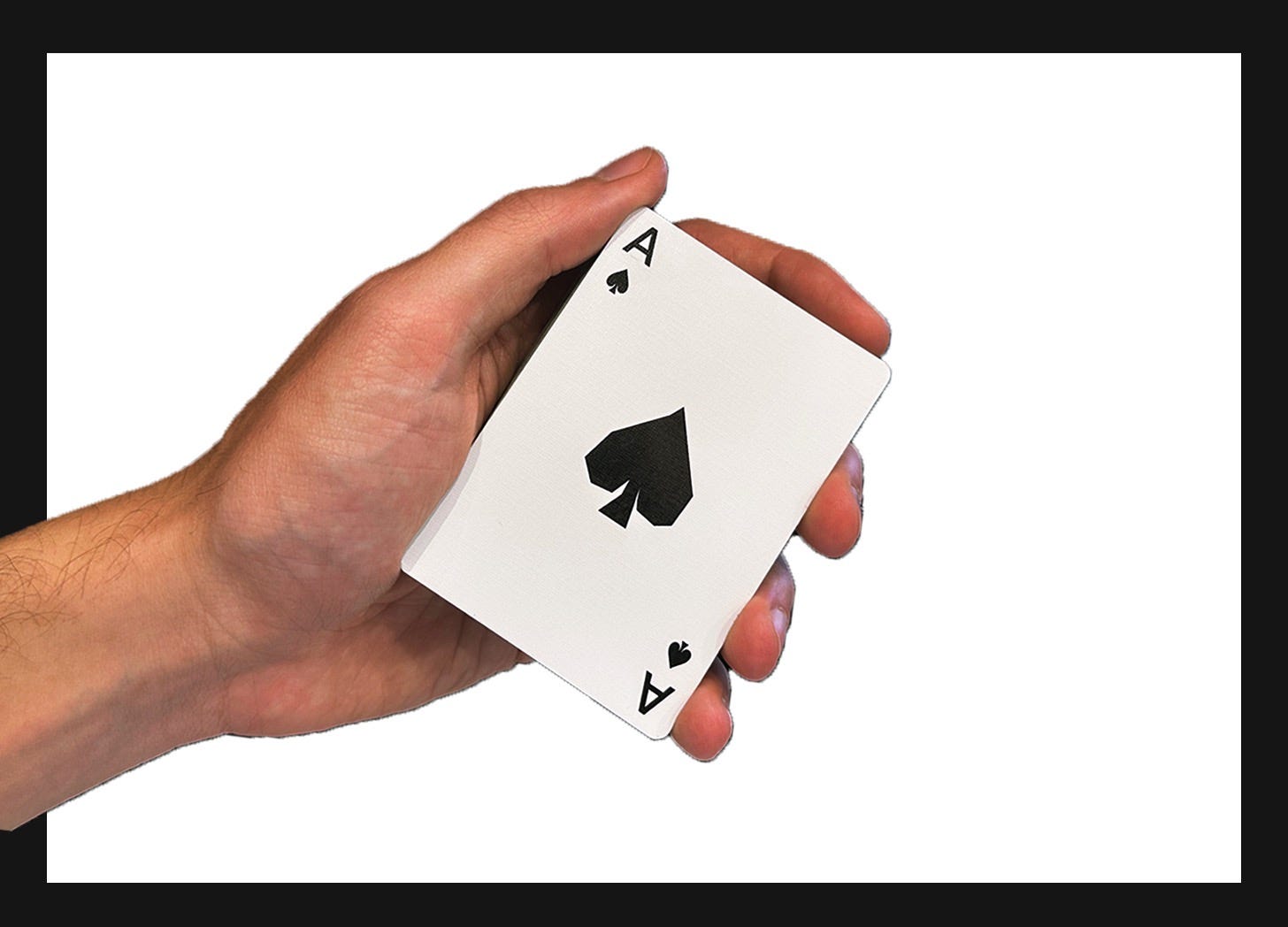
Everything you do has two games: The outer game, and the inner game.
Cardistry is no different.
On the outside, the cards twirl, twist and tumble through your hands in a seemingly magical way. Packets break, combine, and intertwine. It’s a game we are all familiar with, the performance of our beautiful art form.
But under the surface of every cardist, a second game is being played. A mental game. The Inner Game.
The concept isn’t new, it was first established by W. Timothy Gallwey in his 1974 book titled The Inner Game of Tennis. And while the Inner Game was developed during Gallwey’s time as a tennis coach, everything he teaches in relation to tennis can be equally applied to cardistry.
Let me break down this game, and its relation to cardistry, into four lessons.
Lesson #1: Learn Through Observation
We underestimate our ability to learn simply through observation.
In fact, it’s the most natural way of learning. Long before language even existed, humans and other animals have learned through observation – a child learning to walk, a bird learning to fly, a lion cub learning from its mother to stalk prey.
Before you’ve begun to even practice the mechanics of a cardistry move, the learning process has already started. By simply watching the performance of a move, your hands begin to absorb the rhythm, the pacing, and the flow. You see how the cardist emphasizes a display or speeds up and slows down at certain points.
Once we have the mechanics down, only by observing a master perform the move can we fully develop an understanding of how to perform it. There are no verbal instructions for flow or style, it comes through simply watching.
Try this:
Next time you become comfortable with the mechanics of the move:
Download or screen record a performance from its creator.
Drop it in a video editor and repeat the clip 10-15 times (add music if you like)
Simply observe – allow the mind to naturally learn the language of the move.
Watch for as long as you can, without practicing, until you are simply itching to try again.
Lesson #2: Prepare the Mind
A subtle lesson that Gallwey describes is the ability to prepare the mind for mechanical movements.
Jumping into the science for a second (bear with me), mechanical movements happen when neural pathways within our brain send electrical signals through the nervous system to the muscles. When we decide to stand up, grab something, or perform a flourish, that decision activates specific neural pathways that tell our muscles what to do. Over time, as those same pathways are used repeatedly, the connections between neurons become stronger and more efficient. Eventually, the movement can happen with little conscious effort – what we call “muscle memory.”
However, sometimes we hit a bump in the road.
At a certain pain point in our backswing, as Gallwey might note, or a difficult transition within a flourish, our muscle memory hasn’t fully developed and conscious effort rushes in to force the movement to completion.
What was initially a subconscious flow has derailed into a conscious struggle.
To address this, Gallwey urges us to “mentally prepare” for that moment. Before you even reach that point, simply thinking about performing that motion ahead of time warms up those neural pathways, so that when they are called upon to fire, they’re primed and ready to go.
Try this:
Next time you’re having difficulty at a certain moment in a move:
Before you even begin that move, think of that pain point you wish to improve.
Hold the mechanics of that moment in your mind – what fingers are required, the flow that you wish to achieve, how it starts and how it ends.
Observe yourself as you perform the move, imagining what motions your fingers will launch into when you reach that particular moment.
When you eventually reach that point, fire your fingers into motion. Just as you imagined.
This gives your muscles “head start” on that pain point, eventually embedding it into your muscle memory even quicker.
Lesson #3: A Performance is Neither “Good” nor “Bad”
Gallwey describes two selves in the book:
Self 1 – the teller
Self 2 – the doer
The Inner Game is all about the balance, or battle, that happens between these two. Self 1 dictates the mechanics through judgement (“that performance was too choppy” or “the opener wasn’t fast enough”) while Self 2 simply does. No instructions are needed, it simply performs the actions. It already knows what to do.
The problem is that Self 1 rarely stays quiet. It passes judgement on every dropped card or fumbled display, building frustration and ultimately leading to unnatural movements and overcorrections.
Gallwey’s advice is to replace judgement with observation of the self.
Similar to meditation, where you simply observe what you’re feeling, your goal here is not to judge whether your performance of a move is “good” or “bad,” but to simply watch what you did.
This doesn’t mean to not strive for improvement, but recognizing that judgement, both positive and negative, leads to us building unnecessary tension (putting pressure on ourselves to keep up a good performance, or frustration after we keep dropping packets). Over time, this judgement wears away at our performance.
Try this:
Next time you feel yourself judging your own performances:
Record yourself doing the move.
In an almost scientific way, simply observe and take note of what you do.
Notice the movements, the flow, the pacing. See what actually happened without judging it as good or bad.
Then without telling yourself how to improve, practice the move again and observe how your hands naturally correct on their own.
Simply let it happen. Trust your Self 2.
Lesson #4: Quiet the Mind
The overarching goal of The Inner Game of Tennis is focused concentration – the inner game of cardistry is no different.
While cardistry naturally lends itself to putting the performer in a meditative state, there is a higher level of concentration and performance that can be achieved when the mind is truly quiet. When the noisy judgment of Self 1 ceases to exist.
To achieve this state requires focus.
One of Gallwey’s tennis tips for this is to concentrate on the seams of the tennis ball. As you focus your mind on such a minute detail of your performance, the typically noisy Self 1 tends to quiet. You’re not worrying about which mechanics you’re doing right or wrong. You’re focusing your conscious attention on the details of a near-invisible aspect of your craft, allowing your body to simply go through the motions uninterrupted.
Your Self 1 has nothing to tell you, and your mind quiets.
Try this:
Next time your mind is too noisy:
Focus on your left thumb.
Notice the packets it connects to when performing the flourish.
How it moves without you even directing it – bending, connecting, readjusting as your fingers simply go through the motion of the move.
Your mind forgets the instructions it was trying to tell you, and you can simply allow your hands to perform the flourish.
Closing Thoughts
Unlike the outer game of cardistry, the inner game isn’t about mastering the mechanics. It’s about mastering your mind.
Allowing the simple observation of another cardist’s performance to guide the rhythm of your own.
Preparing the neural pathways in your mind and fingers for the motions of a particular pain point in a flourish.
Letting go of both positive and negative judgement in your performances.
Quieting your mind, allowing focused concentration to take control and simply letting your hands perform the move on their own.
These tips don’t come naturally, and there is no muscle memory that can help to lock these into our brains. But every so often, a simple reminder of this inner game we all play can be enough to bring your cardistry to the next level.
About the author, Conor O’Kane:
Conor has been doing cardistry for over 15 years. Three years ago, he started his cardistry brand, SQUAREUP, with his hometown friends Dom Corrado and Max Galarce. His mission with SQUAREUP is to bring cardistry to the world, introducing the art to those who’ve never heard of it while continuing to expand and contribute to the current community. Through SQUAREUP he also co-runs their monthly cardistry newsletter, A Cut Above, which can also be found on Substack. You can find more from Conor and SQUAREUP on squareupcards.com and @squareupcards on Instagram, YouTube, and TikTok.
Liked what you read? Tell us in the comments!