


Some moves are so commonly done, and have been around for so long, that people aren’t sure of where they came from. Having an understanding of what has been done in the past can better inform us of what we can create in the future. So I thought that I would go over a few moves that are extremely familiar to cardists, but also have been around longer than they have, as people have been flourishing for quite some time. I hope that this gets you curious.
Deck Flip
The deck flip is a move originally published by St. Louis magician T.G. Murphy in 1976. He shared it in a pamphlet entitled The Triple Cut, as it was used in this three-packet cut of his. This instructional was promoted by him by placing advertisements in various magic magazines, such as the one seen here:

In 1988, T.G. Murphy also taught the move in his book Imagication under the name Reverse Mid-Air Triple Cut. The move consists of riffling a third of the deck after crossing your hands, deck-flipping it to your right hand, repeating that with a second packet, then doing a 720 deck flip to bring the last packet to the others. He also showcases multiple variations of the cut that produce one or more cards. See the image below from Imagication:
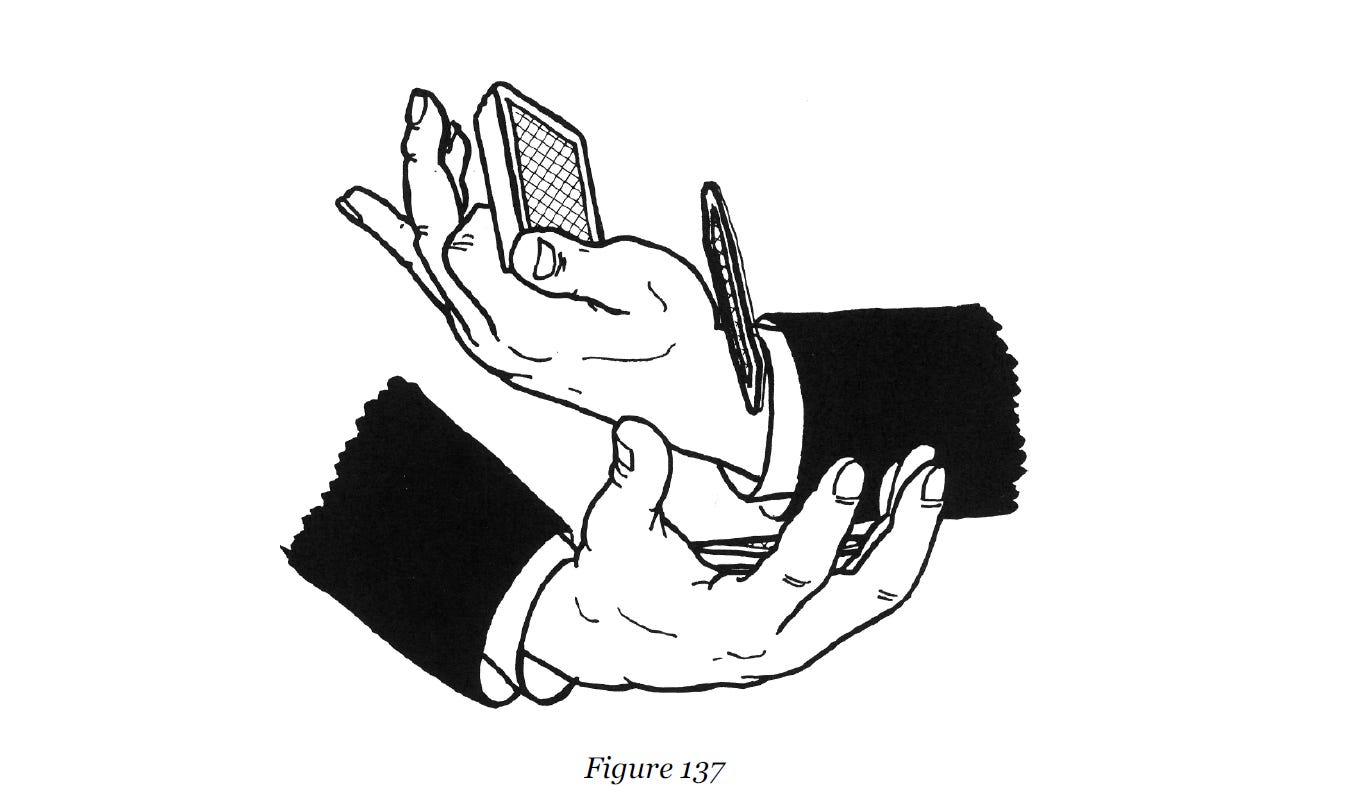
Interestingly, in Imagication, he doesn’t refer to the deck flip itself as the “deck flip”, but as “the snap.” This phrasing is also used when Lee Asher explains the deck flip in his Diving Board Double (2005) tutorial. Lee Asher first showed this move to Dan and Dave Buck. When sharing it with them, he also showed them versions where the deck would flip in the same hand 360 degrees and optionally include card productions. This later influenced some of the Bucks’ creations, such as Zero Gravity (2000), Air Born (2000), and Molecule 2 (2004). Their use of the deck flip within Molecule 2 and as a standalone flourish had the most significant impact on its direct spread, as cardists all over started doing this move.
See these explanations of Zero Gravity and Air Born from Artifice, Ruse, and Subterfuge in the Hands:
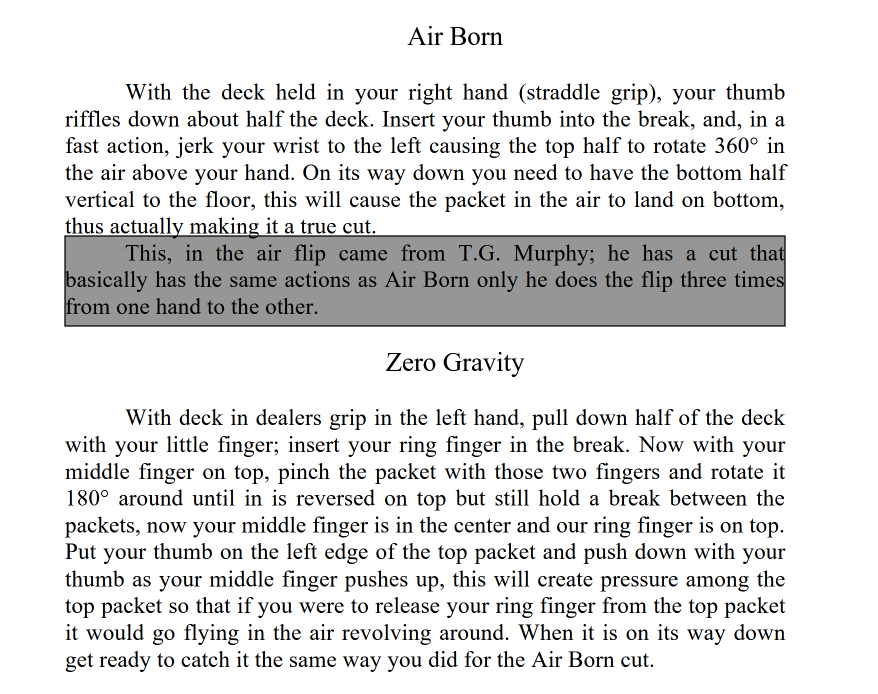
Astute readers will notice that the description of Zero Gravity matches a move that was later independently created by Daren Yeow, i.e. Dynamite. The Bucks’ version includes a Charlier Cut at the end to make it a true cut, unlike Daren’s. Subsequently, Daren also influenced Harapan Ong and his Dynamite Triumph (2023) and Jonas Haglund and his move Wrist Twist (2007). Specifically, there is a variation on Wrist Twist that ends with Dynamite, which can be seen here.
In 2017, moves using the deck flip gained a resurgence, for example, as seen here in Gaolock aka Cong Le’s triangle deck flip (2017). Even more influential was the frequent use of Zero Gravity, popularized by Tobias Levin and Nikolaj Pedersen on their Instagram accounts and in the video Last Minute. Some other notable moves involving the deck flip:
Jerry Cestkowski describes the Twisting Deck Flip in the Encyclopedia, which utilizes two hands. He notes how difficult it is to do a deck flip on the opposite axis.
A one-handed version of the Twisting Deck Flip can be seen here, performed by Lunii Ghost. I am unsure of the first person to do this move, but it has been around for a long time and has been referred to by some as Hardflip.
Leon Sánchez’s German Deck Flip is like the previous one, except that he uses the left thumb to propel the rotation of the deck at the end of the spin.
Sean O. has moves where, using the opposite hand, he taps the flipping deck mid-air to change its rotation.
Last but not least, I will leave you with one of my favorite moves involving the deck flip, Kevin Ho’s Molecule 2 Aerial Drone Strike, a variation on Molecule 2.
Yo!
Another move people learned about from Daren is Yo! by Lee Asher. Lee Asher first published it in his booklet Sex Sells in 1998, then later again in 2003 in Hit the Road, which coincidentally includes the aforementioned Molecule 2. Notably, Yo! was originally done by Lee horizontally, but is more commonly done vertically. This vertical variation of Yo!, created by Daren, is most prominently seen in Air Time (2015). In addition, this move was made more ubiquitous through performances by Zach Mueller, Alejandro Portela aka The Cuso, and Aviv Moraly.
Curly Cue
This move was originally created by Randy Holt and published in Paul Harris Reveals Some Of His Most Intimate Secrets (1976). It went by the name The Curley-Cue-Move, which is different from the more commonly used Curly Cue or Curly Q. This move is based on Paul LePaul’s Hop Spread, aka the LePaul Spread, which was published in The Card Magic of Paul LePaul (1949). It was briefly mentioned twice in Jerry Cestkowski’s Encyclopedia of Playing Card Flourishes, however, he wasn’t a fan due to it being “an example of focusing unnecessary attention on the formation of a fan rather than on the fan itself.”
The move was thrown into the mainstream cardistry lexicon by Zach Mueller, first seen performed by him in his video Gruzen (2013) and later in many others, such as wrist (2015). It became so common that a dedicated Instagram page was created for it, called curly_q_is_bae. One variation is the Giant Curly Cue. Even more popular is Curly Cucu by Alejandro Portela. There is a dedicated page for this move too, i.e. curly_cucu_is_bae. In addition to Zach, I would be remiss not to mention Mads Schatz-Jakobsen (madschtz), who developed quite the following fueled by Curly Cues and Cucus.
Credits and Thanks
Imagication by T.G. Murphy
Diving Board Double by Lee Asher
Artifice, Ruse, and Subterfuge in the Hands by Dan and Dave Buck
M-U-M July 1977, Vol. 67, No. 2, p. 48 and the Society of American Magicians
About the author, Ethan Butler:
Ethan Butler is a cardist from Atlanta, GA that has been shuffling for over a decade. You can find him on Instagram @ethanbtlr
Liked what you read? Let us know in the comments below!